Recipe for “Languages of the Americas”
As part of the “Food of the World” segment in my “Languages of the World” course at NTU Singapore, I’ve been cooking food from a region of the world that we discuss, so students get an idea of possible foods in a fieldwork situation. The course provides an overview of world languages, highlighting theories about language development and human migration, as well as surveying major families, linguistic typology, and the cultures and practices of different groups. The weeks where we sample food are also the weeks in which students present, so each group of students can have a say in what gets prepared. Today I’m posting a recipe from the Americas, based on the topic from week 9 of presentations. This was also the final week of student presentations for the semester, so I won’t be posting more recipes until I run the course again.
Restrictions
To cater for various student backgrounds and dietary restrictions, I restrict or modify recipes to be vegetarian/Buddhist (Mahayana) friendly. This means avoiding onions, garlic and other pungent vegetables. I also list out all the ingredients and preparation beforehand, so students can decide whether to partake in the week’s option. And of course I ask students to let me know of any allergies ahead of time.
Recipe for “Languages of the Americas”: Three Sisters stew
The ninth week of presentations we covered the continents of North and South America. This area is likely the last-populated region of the world, as people moved out of Africa and into Asia, crossing the Bering Sea into northern America before migrating further south into Central and South America. This was still a pretty long time ago, which means the peoples and their languages show quite a lot of diversity. The lecture for this week provided an overview of the cultures and languages represented by the over 120 language families of the Americas, with some very interesting sound systems and grammatical systems. There are even languages that have been claimed to not distinguish between noun and verb classes, which is thought to be a central property of human language.
The students didn’t have a particular preference for food, so I did some investigation and asked some folks online for suggestions on what to make. One linguist on X (Twitter) suggested that I make something with acorns, but that’s a bit hard to find in Singapore:Southern Pomo ṭʰoʔ:o [ˈt̠ʰo̞ʔːo̞] ‘acorn mush’ and si:lun /ˈsiːlun/ ‘acorn bread’ were staff-of-life foods in what is now Sonoma County, California https://t.co/EdsctjFs7V
— Dr Neil Alexander Walker (𐐝𐐲𐑄𐐲𐑉𐑌-𐐺𐐫𐑉𐑌) (@neilalexanderw1) March 30, 2026
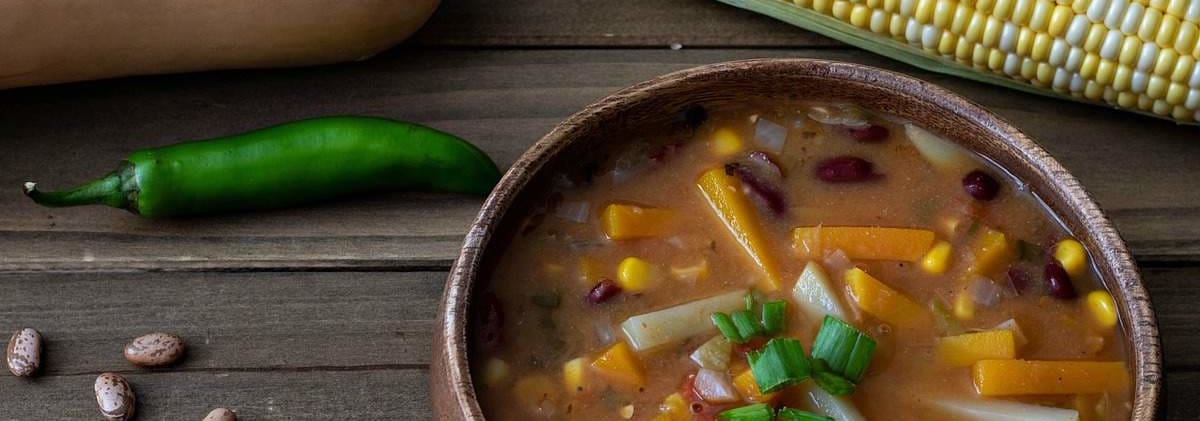
Instead, we went with a tasty and nutritious vegetable stew, which incorporates ingredients native to the Americas, such as squash, beans, corn (the three sisters), peppers, and sweet potato. I went a bit easy on the pepper, but made it available for students to season the stew. As always, I take inspiration from various online recipe sources (some of which I can’t find at the time of writing this post), but with some modifications.
Three Sisters Stew
Ingredients:
- 1 cup vegetable stock or water
- 1 hot chili pepper fresh, seeded and minced; or one 4-ounce can chopped mild green chilies
- 2 teaspoons cumin
- 2 teaspoons chili powder or mesquite seasoning, add more to taste
- 1 teaspoon oregano
- 1 can diced tomatoes canned, with liquid
- 1-2 cans beans (pinto/kidney)
- 2 cups or 1 can of kernel corn
- 1 bell pepper medium, green or red, cut into short narrow strips
- 2 tbs olive oil
- 1 large butternut squash or sugar pumpkin, roughly 1kg
- 1 large cut sweet potato
- salt
- black pepper
- fresh cilantro or parsley, chopped
How to cook:
- Put all cut vegetables and other ingredients in a large pot
- If using a crockpot, heat on low overnight or on high for 4-6 hours.
- If using a large pot, bring to a boil, then simmer for 1-2 hours.
- Take off heat and let pot sit for 1 hour before reheating for serving.
- Serve with cilantro/parsley and/or cornbread.
Notes:
This was a very tasty meal. It reminded me a bit of the typical central American chili (bean stew) that is a family favorite. I think the corn really pulls the whole dish together, though of course there’s lots of different variations - maybe I’ll try a different style next year!