Recipe for “Languages of Europe”
This week’s post is a recipe from Europe. As part of the “Food of the World” segment in my “Languages of the World” course at NTU Singapore, I cook food from a linguistic group represented in that week, so that everyone can get an idea of possible foods in a fieldwork situation. The course provides an overview of world languages, highlighting theories about language development and human migration, as well as surveying major families, linguistic typology, and the cultures and practices of different groups.
Restrictions
Given the mixture of student backgrounds and to cater for various dietary restrictions, I modify recipes to be vegetarian/Buddhist (Mahayana) friendly, which means avoiding onions, garlic and other pungent vegetables and listing out all the ingredients and preparation beforehand, so students can decide whether to partake in the week’s option. I also ask students to let me know of any allergies on the first day of class.
Recipe for “Languages of Europe”: Koprová omáčka
The sixth week of presentations the students focused on three language families: Germanic, Romance, and Slavic. These three families represent nearly 90% of the languages spoken in Europe, or 700 million people. While all belong to the same larger family/phylum (Indo-European), there are some major differences between the languages that speak to the complex histories of the areas where the languages are spoken.
One of the presenting students was on exchange from the Czech Republic, and suggested that we try a traditional Czech dish based on cream and dill. One of the major reasons for Indo-European expansion was the domestication of cattle and a genetic trait called “lactase persistence” or “lactose tolerance”, which allows adults to process milk more easily. So this was a great recipe to try.
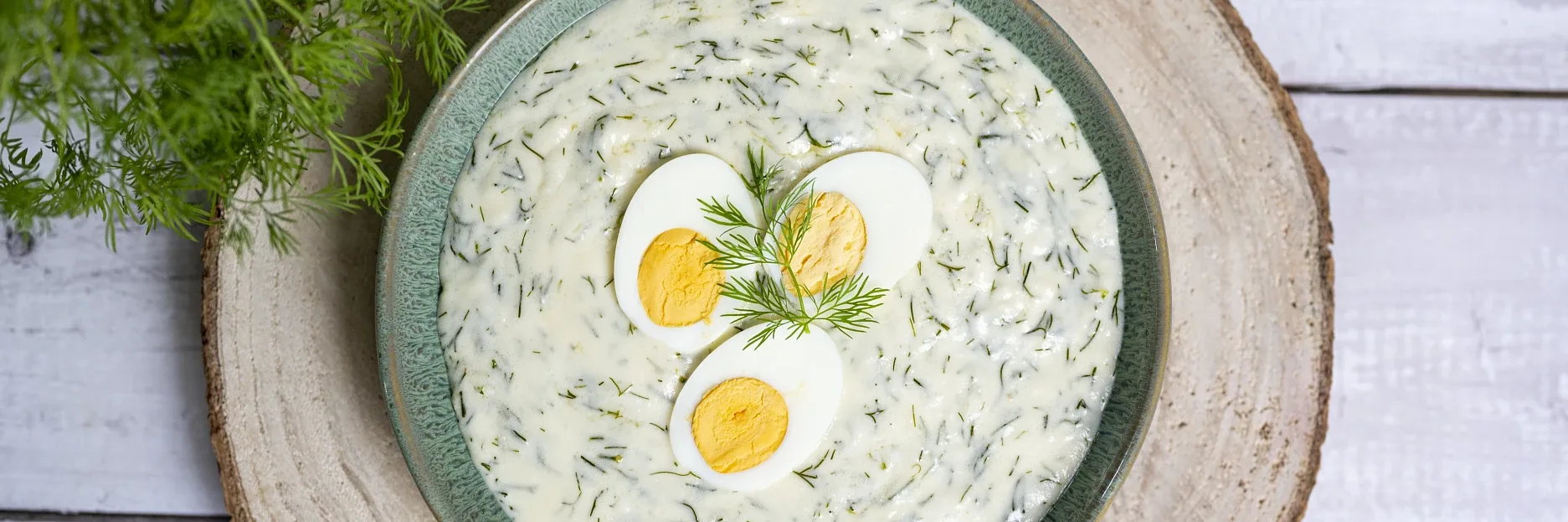
Koprová omáčka (Czech dill sauce)
Ingredients:
- fresh chopped dill
- oil
- all purpose flour
- milk
- salt
- sugar
- white vinegar
How to cook:
- Chop 1/3 cup dill (without stems) and set aside
- Put 1/4 cup oil in a large pot and set stove to high
- Add 1/3 cup flour
- Stir well until thoroughly mixed, then lower heat to medium
- Stir until light brown and bubbly, add 4 ½ cups milk, 1 tsp salt and 1 tsp granulated sugar while stirring
- Turn heat to high and bring to boil while stirring so the milk does not burn
- When mixture has started to boil and thicken turn heat down to medium, continue stirring until sauce is thick, then turn off stove
- Add 1/3 cup chopped dill, mix in
- While stirring, with stove off, slowly add 1 tsp white vinegar
- Pair with hard boiled eggs or cooked beef, dumplings or potatoes.
Notes:
The traditional sauce is usually served with potatoes or dumplings, but I didn’t quite have the ability to do this, so I just boiled some eggs and offered different kinds of breads on the side. Our exchange student said the result was pretty decent and reminded her of home, so it was nice to hear that I didn’t screw up the recipe!