Recipe for “Austronesian Languages”
This week’s post is a recipe from the insular south-east Asian region of the world. As part of the “Food of the World” segment in my “Languages of the World” course at NTU Singapore, I cook food from a linguistic group represented in that week, so that everyone can get an idea of possible foods in a fieldwork situation. The course provides an overview of world languages, highlighting theories about language development and human migration, as well as surveying major families, linguistic typology, and the cultures and practices of different groups.
Restrictions
Given the mixture of student backgrounds and to cater for various dietary restrictions, I modify recipes to be vegetarian/Buddhist (Mahayana) friendly, which means avoiding onions, garlic and other pungent vegetables and listing out all the ingredients and preparation beforehand, so students can decide whether to partake in the week’s option. I also ask students to let me know of any allergies on the first day of class.
Recipe for “Austronesian languages”: Nasi Lemak
The fourth week of presentations the students focused on a couple of Austronesian languages. Austronesian is one of the largest language families of the world, with roughly 1,200 languages and 270 million speakers. It also has one of the largest geographical spreads of any languages, with speakers located throughout the Pacific and neighboring regions, as well as in Madagascar. Its broad spread is partly due to the technological advancements that Austronesian peoples developed for sailing and navigation, allowed them to migrate relatively recently from Taiwan, where the most diverse Austronesian subgroup, the Formosan family, is still found.
The students requested Nasi Lemak, which is a coconut flavored rice that is easy to prepare and goes well with many different kinds of sauces. To get the traditional flavors, you really need access to pandan leaves and lemongrass, but even just adding coconut milk to your rice can give you a nice aroma. The following recipe is adapted from What To Cook Today.
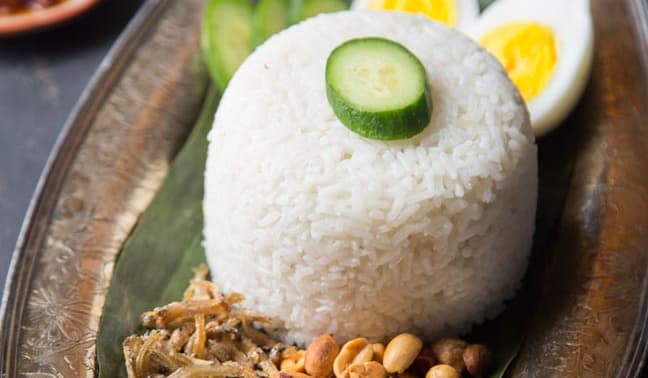
Nasi Lemak
Ingredients:
- 3 cups jasmine rice or any white long-grain rice
- ½ cup coconut cream (thick coconut milk)
- 3 cups water (add another 1/2 cup if cooking on the stove)
- 2 pandan leaves (screwpine leaves-knotted)
- 1 stalk lemongrass (bruised)
Optional ingredients:
- 2 tsp cooking oil
- 1 cup dried anchovies
- 1 cup dry roasted peanuts
How to cook rice:
- In a rice cooker or pot, add the rice, water, cream, leaves, and lemongrass
- Cook on auto until done
How to cook peanuts:
- Fry oil, peanuts, anchovies in a pan, add salt to taste.
Notes:
Pandan leaves are likely the most difficult part to source. They add a mild but particular flavor that is hard to match. Rather than trying to find a substitute, it is probably best to leave them out if you can’t get ahold of them. All amounts of ingredients can be adjusted to taste.