Recipe for “Languages of SE and E Asia”
As part of my series on “Food of the World”, I’ve been writing up the recipes for food I cook for my “Languages of the World” course at NTU Singapore. It’s a course that gives an overview of world languages, highlighting theories about language development and human migration, as well as surveying major families, linguistic typology, and the cultures and practices of different groups. The food component, where I cook food from a linguistic group represented in that week, gives an idea of possible foods in a fieldwork situation.
Restrictions
Given the mixture of student backgrounds and to cater for various dietary restrictions, I restrict or modify recipes to be vegetarian/Buddhist (Mahayana) friendly, which means avoiding onions, garlic and other pungent vegetables and listing out all the ingredients and preparation beforehand, so students can decide whether to partake in the week’s option. I also ask students to let me know of any allergies on the first day of class.
What are “Languages of SE and E Asia”
The second week of presentations we covered the languages spoken in South-East and East Asia. This is a very large area with some incredible diversity in terms of languages, cultures, and foods, along with a rich history.
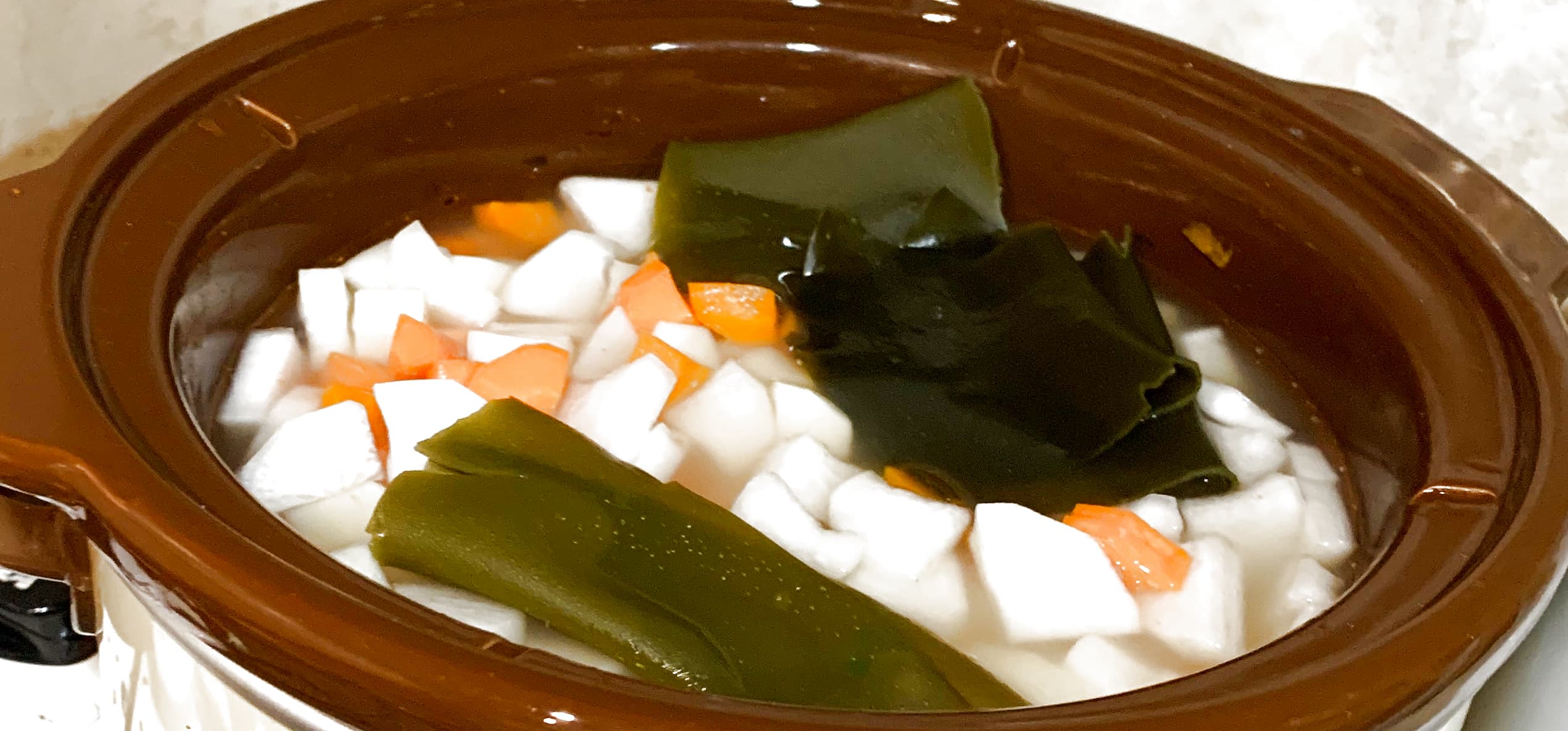
The students were presenting on Ainu, a language isolate spoken mainly in Hokkaido. I found a few recipes for Ainu dishes from Ainu Shaman, and decided to try the “Hokkaido Sanpei Jiru”, a traditional mackerel soup. With some modification, I prepared the following Mahayana-vegetarian-friendly version.
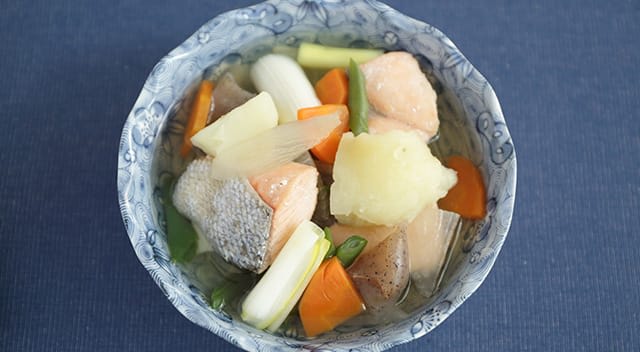
Ainu vegetable soup (Sanpei Jiru)
Ingredients:
- kombu (seaweed for soup stock) - 3x3 inch piece
- carrots
- radishes
- potatoes
- salt (optional: sake)
How to cook:
- Peel and cut the vegetables into cubes
- Bring a large pot of water to a boil
- Put in a large pot, add 4 cups of water and kombu, cover with a lid
- Boil about 5 minutes, remove kombu
- Add the vegetables and cook till tender (in my case, overnight in a crockpot on low)
- Add sake (if desired) and salt to taste
Notes:
The kombu is probably the most
difficult aspect to source, as not all regions
will have seaweed available. Since it is there
to add the leafy/salty flavor, you could
probably substitute it with another leaf
vegetable as you boil the stock. I didn’t add
any of the sake (traditional
Japanese alcohol), and what seems to really have
made it flavorful is the combination of the
different vegetables. This would probably taste
somewhat different with the traditional
mackerel, but I’m pretty happy with how it
turned out, and judging by the fact that none
was left, it seems the students enjoyed it
too!